



What Is Digital Minimalism (and Why Students Need It)?
Digital minimalism is the intentional use of technology—focusing only on tools that support your goals while eliminating distractions.
For Gen Z students, this matters more than ever.
The average student spends 6–8 hours daily on screens outside of academic work, which leads to:
- reduced attention span
- poor memory retention
- increased academic stress
If you’ve ever struggled to focus on studying for more than 20 minutes, your screen habits may be the reason.
The Science of Distraction: How Screen Time Affects Your GPA
Finding a sustainable balance between social connectivity and academic excellence is the ultimate challenge for modern students. When academic pressure builds during midterms or finals, many realize how much time is lost to digital distractions. In such situations, students often explore options like assignment help to better manage their workload. Platforms such as myassignmenthelp are commonly used by students to handle time-consuming academic tasks while they focus on improving concentration and study habits.
Every notification triggers a small release of dopamine—the brain’s reward chemical. Over time, your brain becomes wired to seek quick stimulation instead of sustained focus.
This leads to a problem called context switching.
Definition:
Context switching is when your brain shifts between tasks (e.g., studying → checking your phone → returning to studying).
Research suggests it can take up to 20–25 minutes to regain full concentration after a distraction.
What this means for students:
- Checking your phone 4–5 times per hour = no deep focus
- Reduced efficiency = longer study hours
- Lower-quality work = lower grades
Step-by-Step Digital Declutter Plan
If you want to reduce screen time effectively, you need a structured reset—not just “trying harder.”
1. Audit Your Screen Time
Check your weekly screen report and identify:
- most-used apps
- time spent daily
- peak distraction hours
Goal: Identify “time-wasting” apps.
2. Remove or Limit High-Distraction Apps
Delete or restrict apps that don’t add value, such as:
- endless scrolling platforms
- non-essential games
- distracting notifications
3. Reorganize Your Phone
- Move essential apps off your home screen
- Keep only tools like notes, calendar, and study apps visible
This reduces unconscious app opening.
4. Switch to Grayscale Mode
Turning your phone black and white:
- reduces visual stimulation
- makes apps less addictive
This simple trick can significantly cut screen time.
5. Turn Off Non-Essential Notifications
Disable notifications from:
- social media
- shopping apps
- entertainment platforms
Keep only:
- calls
- important messages
Study Smarter: Turning Focus Into Better Grades
Reducing screen time is only the first step toward academic improvement—you also need smarter study strategies. When deadlines overlap and time becomes limited, some students choose to pay for assignment support to manage specific tasks more efficiently. Services like myassignmenthelp are often considered by students who need structured assistance, allowing them to free up time for deep work, revision, and concept clarity.
1. Use Time-Blocking for Deep Work
What is deep work?
Deep work is uninterrupted, high-focus study time where real learning happens.
Try this method:
- 60–90 minutes focused study
- 10–15 minute break
- repeat 3–4 times
During focus time:
- no phone
- no social media
- no unrelated tabs
2. Use “Do Not Disturb” Mode While Studying
This prevents:
- mental interruptions
- urge to check notifications
Even silent notifications can reduce concentration.
3. Switch to Handwritten Notes
Studies show writing by hand:
- improves memory retention
- enhances understanding
- forces active thinking
Use notebooks for:
- lectures
- summaries
- revision
4. Create a Dedicated Study Environment
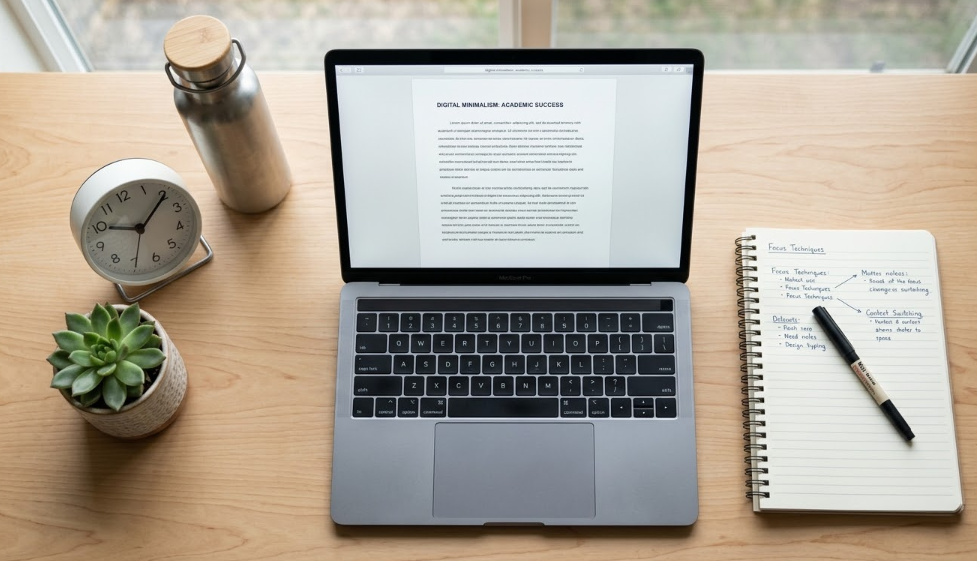
Your brain associates spaces with behavior.
Best practice:
- one place only for studying
- avoid studying in bed
- keep your desk distraction-free
This improves focus and reduces procrastination.
Long-Term Benefits of Digital Minimalism
1. Better Academic Performance
- improved concentration
- faster learning
- higher-quality assignments
2. Reduced Stress and Anxiety
Less screen time means:
- less social comparison
- lower mental overload
- better emotional balance
3. Improved Sleep Quality
Blue light from screens affects melatonin production.
Solution:
- avoid screens 60 minutes before bed
- use this time for reading or planning
Better sleep = better memory and focus.
4. Stronger Critical Thinking Skills
Without constant distractions, you:
- think more deeply
- analyze better
- develop original ideas
These skills directly impact academic success.
Quick Summary: How to Boost Your GPA with Digital Minimalism
- Audit your screen time weekly
- Remove or limit distracting apps
- Use grayscale mode to reduce phone addiction
- Study in focused time blocks
- Take handwritten notes
- create a distraction-free study environment
The goal is simple: control your technology instead of letting it control you.
Frequently Asked Questions
How does reducing screen time improve academic performance?
Reducing screen time minimizes distractions, allowing your brain to focus deeply. This improves memory retention, understanding, and overall study efficiency—leading to better grades.
What is the easiest way to start digital minimalism?
Start with a screen time audit. Identify your most distracting apps, then remove or limit them. Turning off notifications and using grayscale mode are quick, effective steps.
Is it better to study on paper or digitally?
Handwritten notes are generally better for memory and understanding. Writing forces your brain to process information instead of copying it passively.
How many hours should students study without distractions?
Most students benefit from 3–5 hours of deep, focused study daily, broken into time-blocked sessions with short breaks.
About the Author
Alexander Anderson is an educational consultant and academic strategist specializing in student productivity and learning optimization. With over 10 years of experience, he focuses on helping students improve focus, build effective study systems, and achieve sustainable academic success.
