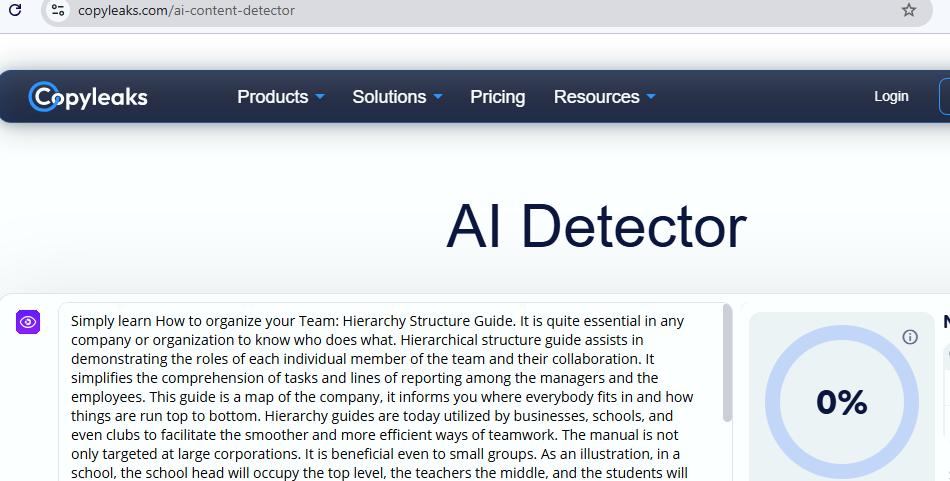


It is quite essential in any company or organization to know who does what. Hierarchical structure guide assists in demonstrating the roles of each individual member of the team and their collaboration. It simplifies the comprehension of tasks and lines of reporting among the managers and the employees. This guide is a map of the company, it informs you where everybody fits in and how things are run top to bottom. Hierarchy guides are today utilized by businesses, schools, and even clubs to facilitate the smoother and more efficient ways of teamwork.
The manual is not only targeted at large corporations. It is beneficial even to small groups. As an illustration, in a school, the school head will occupy the top level, the teachers the middle, and the students will be at the bottom. Similarly, the CEO is on top of the business, the managers are in the middle, and the staff members are at the bottom. To make this clear to all people, using organizational charting software to create a hierarchical structure guide will decrease confusion and enhance cooperation. It ensures that each team member is aware of their position and their contribution to the organization.
Characteristics of Contemporary Hierarchical Structure Guide
A guide of hierarchical structure can be used nowadays and it contains many useful features. To begin with, it presents all the roles in boxes and lines clearly. The role and the title of the job of each individual are clear to read. Others are digital and interactive where you can click on a box to get information on the person or team. When somebody changes his location, you can relocate the boxes also. Others even contain photos and contact details. These characteristics facilitate a situation where everyone can know who does what.
The other important attribute is the real-time updates. The guide can be informed immediately a person enters or exits. It is easy to delegate and distribute tasks among managers. Most guides are cloud based, that is, anyone within the company of that firm can anywhere access them. These characteristics are used to save time, enhance communication and to simplify the organization.
The Advantages of Hierarchy Structure Guide
There are numerous advantages of using a hierarchical structure guide. It makes individuals comprehend their roles and responsibilities and hence it enhances teamwork. Employees understand whom to be accountable thus minimizing the errors and misunderstandings. Managers will be able to provide instructions in a more understandable way, and meetings will take less time, projects will be less problematic. This guide acts as a road map to the organization and it enables all to work in the right direction.
It enhances communication as well. The guide provides the direction of information and makes employees understand whom to address with. The process of planning is facilitated in that managers have a view of all the teams and positions in a single location. It can be used even in little companies, as it makes each member of the group productive and happy. In general, a hierarchical structure guide simplifies the working process in a team in a more systematic way.
How to Select the appropriate hierarchical structure Guide
The selection of the suitable hierarchical structure guide is dependent on the needs and size of the organization. Simple charts might be enough in small teams, whereas in bigger organizations, digital interactive guides might be required. Find updated information in real-time and accessibility in the cloud to have everyone see the changes in real-time. The guide must be easy to understand even to new employees and display the roles and responsibilities.
Other factors include cost and support. There are guides that are free and those with a subscription. Ensure that there is training and customer care. Find guides indicating workflow, team roles, and contact information. It is prudent to test a couple of guides on the way to the right one. The hierarchical structure guide right also makes the teams arranged, efficient and joyful.
Types of Organizational Charts in Hierarchical Structure Guide
A hierarchical structure guide can support different types of organizational charts:
| Chart Type | Description | Best For |
| Top-down | Shows the boss at the top, managers in the middle, and staff at the bottom | Simple organizations |
| Matrix | Employees report to more than one manager | Complex projects and teams |
| Circular | Shows teams working together instead of a strict top-down hierarchy | Collaborative teams |
| Workflow | Focuses on task flow from one person to another | Project management |
These types help organizations choose the best chart for their needs. Top-down charts are simple, matrix charts are flexible, circular charts promote teamwork, and workflow charts clearly show tasks. A hierarchical structure guide can include all these charts to help teams understand roles and workflow easily.
Connection with Other Business Tools
Contemporary hierarchical design allows work using other business applications such as project management systems, emails and diaries. This assists the managers in assigning work directly based on the guide. It may also be linked up with HR systems, and the information about employees can be updated. Integration saves time and makes sure that all people are always at the same page.
The collaboration is enhanced by integration. Ones can view roles and tasks together, monitor progress and make decisions. The performance reviews and reporting are simplified as all information is interconnected. A hierarchical structure guide which can be integrated with the rest of the tools assists the company operating in a smarter and a smoother manner.
Challenges and the possibility of going over them are common and cannot be avoided
At times, it may be difficult to use a hierarchical structure guide. One of them is to maintain it as the team members join, quit, or shift roles. The other hurdle is that it might be confusing in case the chart is too complicated. These problems can be resolved by selecting a guide that is not difficult to edit and displays only required roles. It is easy to use because it is regularly updated and trained.
The resistance of the employees can also be a problem. Some may not like change. It can be helpful to explain the advantages, demonstrate how it enhances work in a team, and make people use it every day. These challenges are made smaller by a simple, clear and readily accessible hierarchical structure guide. It becomes an essential tool to all with constant usage.
The Hierarchy Structure Guide is a guide document on future trends
The future of the hierarchical structure guide tools is quite promising. AI can now recommend superior team arrangements and anticipate issues encountered in the workflow before they occur. The charts are increasingly becoming interactive, colorful, and readable. Visual and interactive visual materials can help employees learn the company structure in a short period.
There is also the big trend of cloud-based collaboration. The same chart is visible to teams in other locations and they can collaborate in real time. The chart can be accessed on phones or tablets because of mobile-friendly guides that will enable employees to access it. The future hierarchical structure guides will be better, quicker, and more beneficial to all kinds of organizations.
Conclusion
A hierarchical structure guide is something that is a must in any organization. It demonstrates work who, how, and how teams interact and information flows. Its use enhances efficiency, team work and communication. Managers and employees are able to collaborate with ease and to accomplish tasks faster. A basic and straightforward guide can help even small organizations. The ideal guides are simple to read, constantly updated, and able to consolidate with other software. The current AI and cloud capabilities improve the ease of collaboration and planning in the daily environment. A hierarchical structure guide is not just a chart, but it is an intelligent tool that assists organizations to become bigger, keep in order, and prosper.